
The Home of

ICL Boulby and Teesdock
The World’s First and Only Producer of

ICL Boulby Mine is an underground mining operation and processing facility located along the North Yorkshire coastline. We are the world’s first and only producer of the multi-nutrient, low-carbon fertiliser, Polysulphate.
The 260-million-year-old raw mineral deposited by an ancient sea called the Zechstein Sea, polyhalite, is extracted from 1,300 meters beneath the Earth’s surface and distributed worldwide from our Teesdock Terminal.
Since the discovery of polyhalite in 1999, we have been committed to expanding the Polysulphate market through continuous research into its potential. Polysulphate and Rock Salt is mined, refined and distributed through our deep sea terminal at Teesdock.
We are proud to be the largest employer in East Cleveland, committed to supporting our workforce and playing a vital role in the local and regional economy. We actively contribute to the community through financial donations and volunteer efforts with local groups.
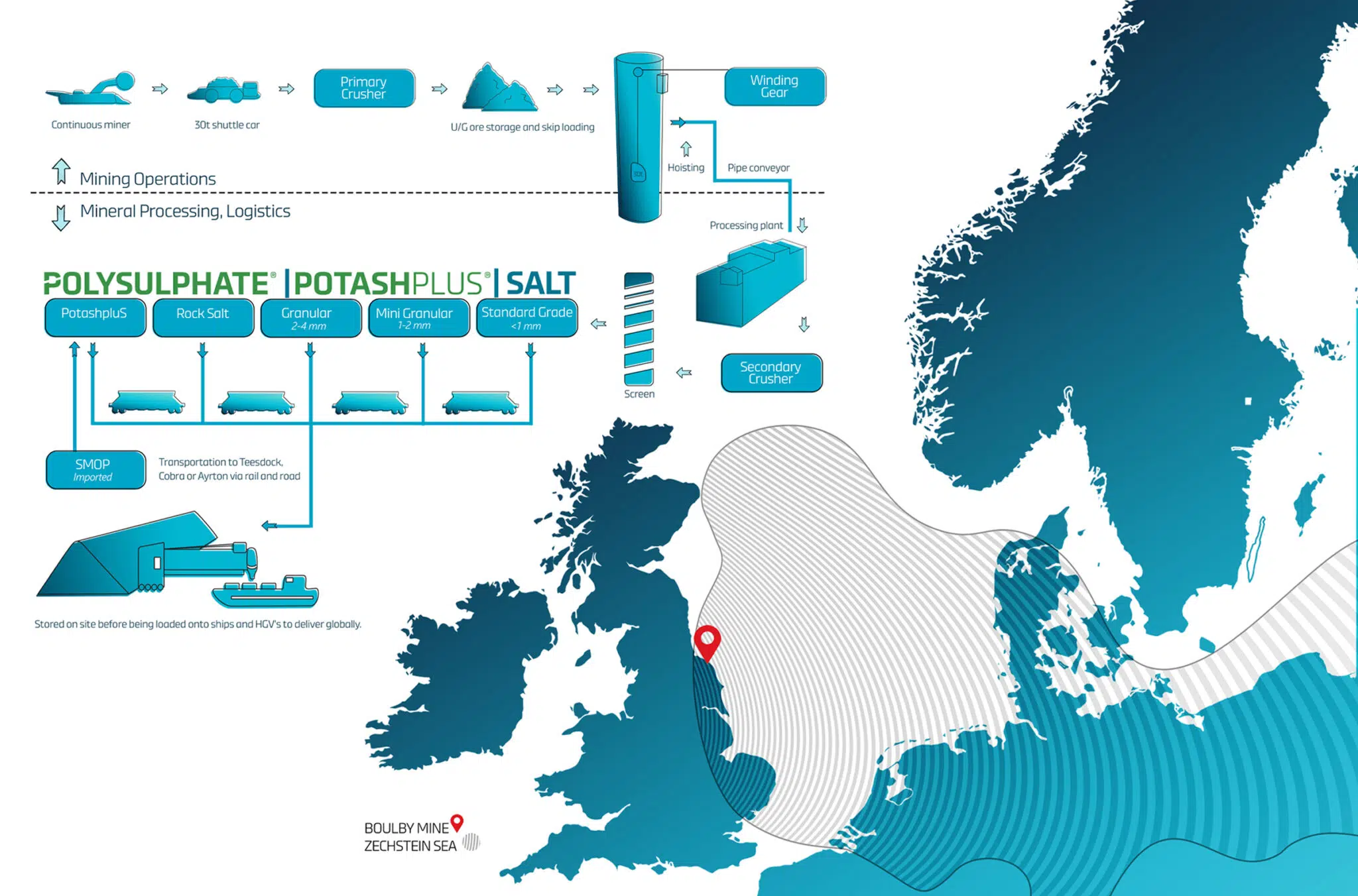
Description of the Boulby operations and distribution diagram
A process diagram of the Boulby operation, from mining underground through to global distribution, set against a map of northern Europe.
Mining operations
The top row follows the ore from the seam to the surface: a continuous miner cuts the ore, a 30-tonne shuttle car carries it to a primary crusher, and the crushed ore goes to underground storage and skip loading. From there winding gear hoists it up the shaft, and a pipe conveyor feeds the processing plant on the surface.
Mineral processing and logistics
At the processing plant the material passes through a secondary crusher and a screen, which separates it into the products sold under the Polysulphate, PotashpluS and Salt brands:
- PotashpluS
- Rock Salt
- Granular, 2 to 4 mm
- Mini Granular, 1 to 2 mm
- Standard Grade, under 1 mm
Imported SMOP joins the same product stream. All of it is transported to Teesdock, Cobra or Ayrton by rail and road, then stored on site before being loaded onto ships and HGVs for delivery worldwide.
The map
The map behind the diagram shows the British Isles and northern Europe. Boulby Mine is pinned on the north-east coast of England, and a shaded area running from the North Sea across into mainland Europe marks the extent of the Zechstein Sea deposit that the mine works.
Full description of the diagram – Boulby Mine mining, processing and logistics process, and its location
Mining Operations (above the dashed line)
The underground process, step by step:
- Continuous miner
- 30t shuttle car
- Primary Crusher
- Underground (U/G) ore storage and skip loading
- Winding Gear – the ore is raised to the surface by hoisting and a pipe conveyor
Mineral Processing and Logistics (below the line)
Processing plant → Secondary Crusher → Screen, producing the following products under the POLYSULPHATE® | POTASHPLUS® | SALT brands:
- PotashpluS
- Rock Salt
- Granular – 2–4 mm
- Mini Granular – 1–2 mm
- Standard Grade – less than 1 mm
- SMOP (Imported)
Each product is loaded onto rail wagons and transported to Teesdock, Cobra or Ayrton by rail and road, stored on site, and then loaded onto ships and heavy goods vehicles (HGVs) for delivery worldwide.
Map
The map shows the United Kingdom, Ireland and Scandinavia around the North Sea:
- Boulby Mine is marked with a red pin on the north-east coast of England.
- The Zechstein Sea is shown as a shaded/hatched area extending across the North Sea into mainland Europe.
Media Hub
Keep up to date with the news and events from ICL Boulby and Teesdock  LINKEDIN See our LinkedIn feed
 FACEBOOK See our Facebook feed
 EVENT/NEWS What’s happening at Boulby and Teesdock
Our People
Senior Leadership Team
Q&A

What is Polysulphate?
Polysulphate is a multi-nutient fertiliser and is is produced from a natural mineral called polyhalite, which is an evaporite mineral containing sulphur, potassium, calcium and magnesium.
How deep is Boulby Mine?
Boulby mine is between 1,100 and 1,400 meters deep, making it the deepest mine in the UK.
What else does Boulby mine?
As well as polyhalite, rock salt is extracted to be used in animal feed and to de-ice the roads of Great Britain.
What is the Boulby Underground Laboratory?
Boulby Underground Laboratory is the UK’s deep underground science facility located 1.1km below ground. Run by STFC (Science and Technology Facilities Council) the science ranges from Particle Physics and Ultra-Low Background science, Earth and Environmental science, Biology / Astrobiology, Planetary Exploration Technology Development and more.